UnscrambleTheWord.co


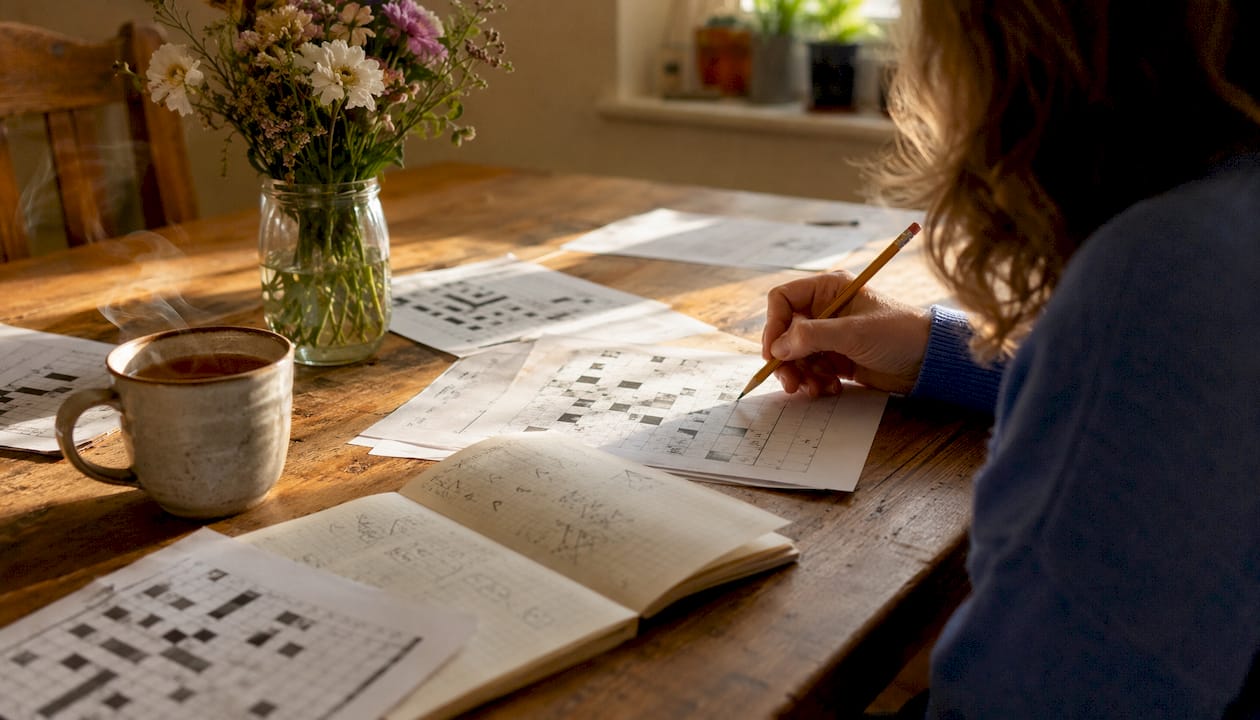
Gentle nudging in word puzzles refers to the deliberate use of light cues or soft hints that guide you toward a solution without handing it over. Think of it as a tap on the shoulder rather than a shout in your ear. You still do the thinking. The puzzle still earns its satisfaction. But instead of hitting a wall and quitting, you get just enough to keep moving.
Here is what gentle nudging actually looks like in practice:
- Vowel placement hints that reveal where vowels sit in an anagram without exposing the full word
- Abbreviation confirmations that tell you a crossword answer is shortened, so you stop hunting for a full word
- Letter count indicators that show how many characters an answer contains
- Structural cues like confirming a word is plural, so you know to look for an “S” ending
- Color or position feedback that signals whether a letter belongs in the puzzle at all
None of these give away the answer. Every one of them keeps you in the game.
How gentle nudging works inside word puzzle design
The design concept behind gentle nudging has a formal name: progressive disclosure. Puzzle designers use it to release just enough information at each stage to maintain momentum without removing the intellectual challenge. You get the minimum assistance needed to stay unstuck, not a shortcut to the finish line.
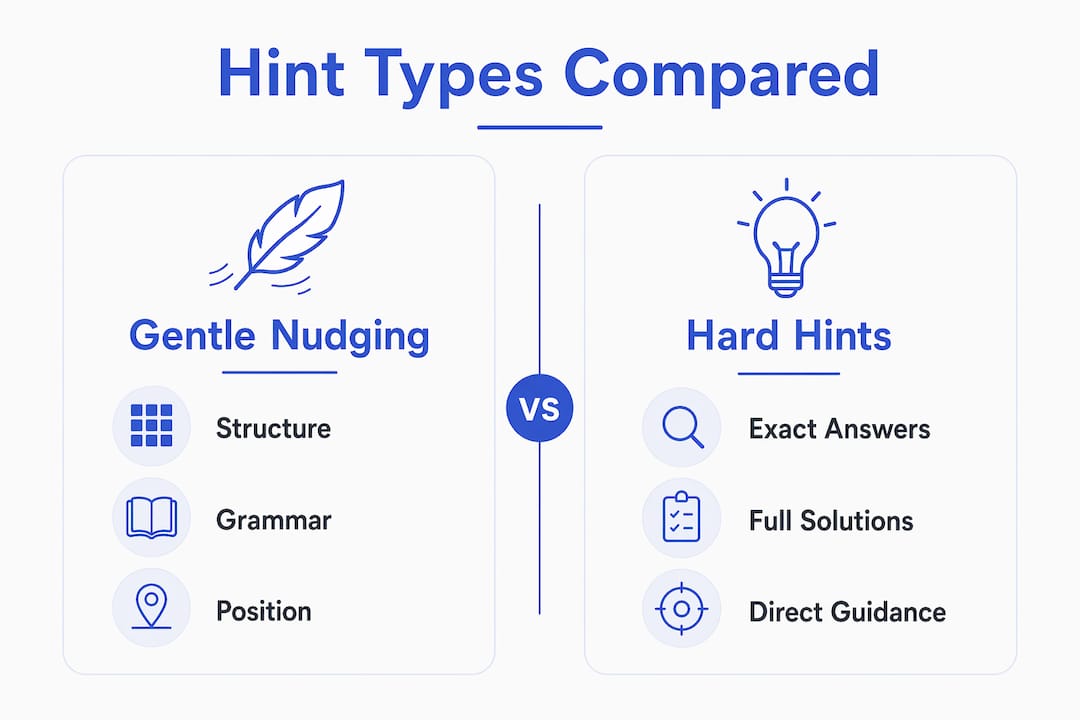
The contrast with hard hints is worth understanding clearly.
| Feature | Gentle nudge | Hard hint |
|---|---|---|
| What it reveals | Structure, grammar, or position | The actual answer or letter |
| Player effort required | High, solver still works it out | Low, answer is near-given |
| Effect on satisfaction | Preserves the “aha” moment | Often removes it |
| Best used for | Reducing dead-end frustration | Last-resort rescue |
| Design philosophy | User-centric, challenge-preserving | Accessibility-first |
Gentle nudges work because they validate player intuition rather than replace it. When you suspect a crossword answer is an abbreviation, a nudge that confirms that suspicion lets you proceed with confidence. You did the reasoning. The nudge just said “yes, you’re on the right track.” That distinction keeps your brain engaged and your frustration low.
Modern puzzle platforms often build graduated help tiers, moving from light nudges all the way to full solutions. Casual players can lean on the early tiers. Experienced solvers can ignore them entirely. The result is a single puzzle that works for a wide range of skill levels without watering down the experience for anyone.
Pro Tip: If you feel stuck, ask yourself what you already suspect about the answer before reaching for a hint. A gentle nudge is most satisfying when it confirms a hypothesis you already formed.
Where you can spot gentle nudging in popular word games
Real puzzles use these techniques constantly, and once you know what to look for, you will notice them everywhere.
- Anagram puzzles often highlight vowels or group letters visually, nudging you toward likely word shapes without rearranging anything for you
- Cryptic crosswords use abbreviation signals in the clue itself, where a shortened word in the clue tells you the answer is also abbreviated, as the National Puzzlers’ League notes
- Crossword grids act as their own nudge system: every letter you place correctly creates crossing letters that constrain and guide adjacent answers
- Wordy Solver integrates this philosophy directly, offering structured hints for Wordle, Connections, Strands, and Spelling Bee that let you choose how much guidance you want, from a light structural cue to a full reveal
- Cryptic puzzles with cross-referencing use already-solved answers as intrinsic gentle nudges, where the filled grid constrains interpretation of harder clues without any explicit hint system
There is also a fun cultural footnote here. “Gentle nudge” appears as a New York Times crossword clue, with the answer being FRIENDLY REMINDER, a 16-letter phrase that captures the concept perfectly. A friendly reminder is polite, low-pressure, and prompts action without demanding it. That is exactly what a well-designed puzzle nudge does.
The best puzzle experiences balance challenge with accessibility. Gentle nudges are the mechanism that makes that balance possible, keeping solvers confident without making the puzzle feel trivial.
Related ideas that connect to gentle nudging in games
Gentle nudging does not exist in isolation. It sits inside a broader family of design concepts that shape how players experience word puzzles.
- Progressive disclosure is the parent framework: reveal information gradually, only when the player needs it, to avoid cognitive overload and preserve engagement
- Flow state is the psychological target: puzzle designers want you absorbed and challenged, not bored or overwhelmed, and nudges are the tool that keeps you in that zone
- Hard hints sit at the opposite end of the spectrum, revealing letters or full answers outright, which trades satisfaction for accessibility
- Metacognitive nudges work at a higher level, like the way a crossword’s grammar rules (plural clue means plural answer) guide your thinking without any explicit hint
- Validation nudges confirm structural hypotheses, such as whether an answer is an abbreviation or a plural form, reducing guesswork frustration while preserving the challenge
- Intrinsic nudges are built into the puzzle structure itself, like crossing letters in a crossword grid, rather than delivered by an external hint system
- Extrinsic nudges come from outside the puzzle, like a hint button or a letter reveal feature, and are most effective when they follow the gentle approach
The psychological effect of a well-placed nudge is confidence. When a puzzle confirms your hypothesis without solving the clue for you, you feel smarter, not helped. That feeling is what keeps players coming back to daily word games day after day.
Key Takeaways
Gentle nudging in word puzzles is a design philosophy that preserves intellectual challenge by offering structural cues, not answers, keeping players engaged and confident throughout the solving process.
| Point | Details |
|---|---|
| Gentle nudging defined | Soft cues like vowel hints or abbreviation confirmations guide solvers without revealing answers. |
| Progressive disclosure | The formal design framework behind gentle nudging, releasing minimal help to maintain momentum. |
| Gentle vs. hard hints | Gentle nudges preserve the “aha” moment; hard hints trade satisfaction for accessibility. |
| Validation over solutions | The greatest value of nudging is confirming player hypotheses, not replacing player thinking. |
| Graduated help tiers | Modern platforms offer tiered assistance, from light nudges to full solutions, for all skill levels. |
Ready to experience gentle nudging in action? Wordy Solver gives you exactly the kind of structured, player-first hints that keep the fun alive, whether you want a small push or the full answer on a tough day.