UnscrambleTheWord.co


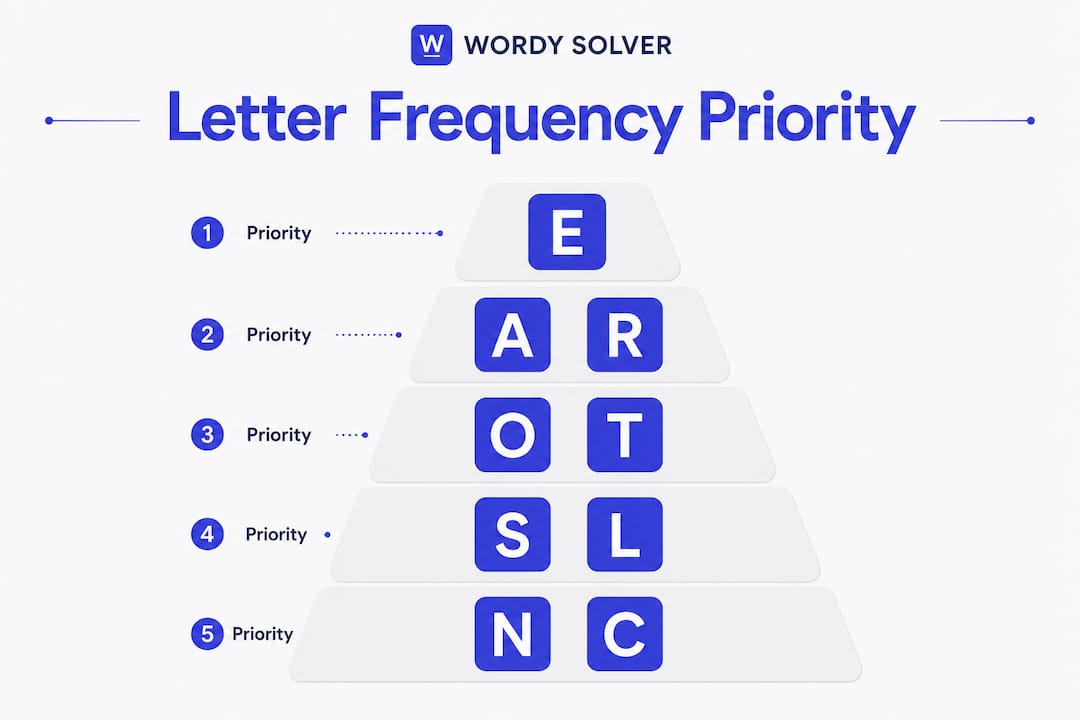
The fastest path to a Wordle win starts before you type a single letter. A solid wordle letter frequency strategy means choosing guesses that pack the most common letters into the most likely positions, cutting the solution space down with every tile you flip. The five most common letters in Wordle’s answer list are E, A, R, O, and T, and building your opening guesses around them gives you an immediate statistical edge. But raw letter counts only tell part of the story. Where a letter lands matters just as much as whether it appears at all.
Here is what a frequency-driven approach actually delivers:
- E, A, R, O, T are the top five letters across Wordle’s 2,315-word answer list. Any opening guess that hits three or more of them is already doing serious work.
- Position-specific frequency changes everything. “S” leads all first-position letters, appearing at the start of over 15% of answers, yet it shows up in the final position less than 2% of the time.
- Entropy-based strategies build on frequency data by calculating which guess eliminates the most possible answers at once. They solve over 99% of puzzles in simulation, compared to roughly 90% for pure frequency methods.
- Wordle-specific data beats general English frequency tables. The game’s curated word list skews differently from everyday English, so relying on standard letter frequency charts will steer you wrong.
- Green, yellow, and gray feedback is where frequency strategy pays off in real time. Each color narrows the remaining word pool, and knowing which letters are positionally common helps you place them correctly on the very next guess.
Combine these five principles and you are not just playing word games. You are solving a math problem with a vocabulary twist.
How letter frequency actually breaks down in Wordle’s word list
Wordle’s answer pool is not a random slice of the English dictionary. It is a hand-curated list of 2,314 common five-letter words, and that curation creates letter distributions that differ sharply from general English text. Understanding those distributions is the foundation of any data-driven approach.
Overall letter frequency in the answer list
The top letters by total appearance across all positions are E, A, R, O, and T. Low-frequency letters like Z, X, Q, and J each appear fewer than 40 times across the entire list, meaning less than 1.2% of answers contain a “J.” Guessing those letters early is a near-certain waste of a turn.
Using Wordle-specific frequencies rather than standard English letter tables is not just a preference. It is the difference between a strategy grounded in the actual puzzle and one built on a misleading approximation.
Positional frequency breakdown
The table below shows how letter frequency shifts dramatically depending on word position.
| Position | Most common letters | Notable pattern |
|---|---|---|
| 1st | S, C, B, T, P | S starts over 15% of answers |
| 2nd | A, O, R, E, I | Vowels dominate heavily |
| 3rd | A, I, O, E, U | Vowels again, with A leading |
| 4th | E, N, S, A, L | E is strongest here |
| 5th | E, Y, T, R, L | Y is a top finisher; S is rare |
A few things jump out immediately. Vowels cluster in the middle positions, which is why vowel-heavy guesses feel productive early on. The fifth position is where the biggest trap hides: in general English, “S” ends roughly 31% of five-letter words because plurals are everywhere. Wordle excludes plurals almost entirely, so “S” as a final letter drops to under 2%. Guessing a word ending in “S” to fish for that position is a losing bet.
Letter repetition and rare letters
- J, Q, and X never repeat within a single Wordle answer. Placing any of them in a guess is a one-shot probe with almost no upside.
- M and P can repeat, with words like “puppy” appearing in the answer list.
- Repeated vowels (like the double “O” in “booze”) do occur, but they are uncommon enough that you should not plan for them until gray and yellow feedback rules out single-vowel options.
Pro Tip: Skip any opening guess that ends in “S.” You are burning a guess on a letter that covers under 2% of final positions in Wordle’s actual word list.
How to apply letter frequency data to your actual guesses
Knowing the frequencies is one thing. Translating them into a real guessing sequence is where players actually improve their scores. The goal of every guess is to eliminate as many remaining possibilities as possible, and letter frequency data tells you exactly which letters carry the most elimination power.

Picking your first guess
Your opening word should cover as many high-frequency letters as possible while balancing vowels and consonants. A 2:3 vowel-to-consonant ratio consistently outperforms vowel-heavy openers like “ADIEU” or “AUDIO,” which front-load vowels but leave too many consonants untested.
Strong opening words to consider:
- ORATE and OATER both contain E, A, R, O, and T, the five most common letters in the answer list. Either word is a statistically sound first guess.
- RAISE hits R, A, I, S, and E, covering four of the top five letters plus the high-frequency first-position letter S.
- SLANE uses the 2:3 vowel-consonant balance and probes S in the first position where it is most likely to appear.
- SOARE achieves one of the highest entropy values among all starting words, roughly 5.89 bits, which reduces the remaining solution space to about 1.7% on average after just one guess.
None of these words is magic. What they share is coverage: each one tests multiple high-frequency letters in positions where those letters commonly appear.
Reading the feedback and adjusting
Once you get your first result, the color feedback reshapes your entire frequency map.
- Green letters are confirmed in position. On your next guess, keep that letter exactly where it is and use the remaining four slots to probe other high-frequency letters you have not tested yet.
- Yellow letters are in the word but placed wrong. Move them to a different position, ideally one where frequency data suggests they are more likely. An “A” that came back yellow in position 2 is a strong candidate for position 3, where “A” is also highly common.
- Gray letters are eliminated entirely. Cross them off your mental list and focus your next guess on untested high-frequency letters.
Pro Tip: After your first guess, do not just guess another word you like. Ask yourself: which remaining letters appear most often in Wordle answers, and which positions have I not tested yet? That question, answered with frequency data, is what separates a 3-guess solver from a 5-guess scrambler.
A real guessing sequence in action
Say your first guess is RAISE and you get: R (gray), A (yellow, position 2), I (gray), S (green, position 1), E (yellow, position 5).
You now know:
- The word starts with S (confirmed green).
- A is in the word but not in position 2.
- E is in the word but not in position 5.
- R and I are not in the word.
Your second guess should place A and E in new positions while avoiding R and I. A word like STALE fits: S (position 1, confirmed), T (untested high-frequency letter), A (now in position 3), L (untested), E (now in position 4). You are still probing new letters while honoring what the feedback told you.
Balancing common and rare letters
Chasing only the top five letters can box you in. Once you have confirmed two or three high-frequency letters, your next guess should probe less common but still plausible letters to distinguish between remaining candidates. If your remaining pool contains words like BLAND, BRAND, and BLAND, the differentiating letter is not a top-five one. Frequency data narrows the field; targeted probing closes it out.
What expert research says about taking your strategy further
Frequency analysis is a powerful starting point, but the research is clear that players who use elimination strategies and dynamically update their guesses based on feedback consistently outperform those who simply chase high-frequency letters round after round.
Why general English frequency tables mislead you
Standard English letter frequency data, the kind you find in cryptography textbooks, is built from enormous corpora of text that include short words, function words, and every plural imaginable. Wordle’s list excludes all of that. The game weights every answer equally across its 2,315 words, so Wordle-specific frequency data is the only reliable foundation for a guessing strategy. Using a general frequency chart is like training for a 5K using marathon pace data. The numbers are real, but they describe a different race.
Entropy: the upgrade beyond frequency
Entropy, in information theory terms, measures how much uncertainty a guess eliminates. A high-entropy guess is one that, regardless of the feedback it returns, leaves you with the smallest possible pool of remaining answers. The SOARE opening word scores roughly 5.89 bits of entropy, meaning it cuts the 2,315-word solution space down to about 1.7% of its original size in a single guess.
Entropy-based solvers do not just pick common letters. They calculate which word, given all possible feedback outcomes, produces the best worst-case scenario. That is why entropy methods solve over 99% of Wordle puzzles in simulation, while pure frequency strategies top out around 90%. The gap is not trivial when you are trying to stay under six guesses every single day.
Key stat: An entropy-optimized first guess like SOARE reduces the average remaining solution pool to roughly 1.7% of all possible answers after one guess.
The vowel-consonant ratio that actually works
Expert analysis consistently points to a 2:3 vowel-to-consonant ratio as the sweet spot for opening guesses. Words with three or more vowels feel productive because vowels confirm quickly, but they leave too many consonant slots untested. A word like SLANE (S, L, A, N, E) probes two vowels and three consonants, covering both the high-frequency vowel zone and the consonant landscape in one shot.
Positional awareness as an advanced lever
Advanced players do not just ask “is this letter common?” They ask “is this letter common in this position?” Placing “S” in position 1 is statistically sound. Placing it in position 5 wastes a slot on a letter that covers under 2% of final positions. That kind of positional thinking, applied to every letter in every guess, is what separates players who average 3.5 guesses from those stuck at 5.
Pro Tip: Once you understand entropy, you can apply it manually. After each guess, mentally ask: “Which word, if I guess it now, would give me useful information no matter what color the tiles come back?” That question is the human version of what entropy solvers compute automatically.
Moving beyond guesswork entirely
The most effective Wordle players treat each guess as an experiment, not a shot in the dark. They enter a word to generate information, read the feedback, update their mental model of the remaining word pool, and select the next guess that maximizes what they learn. Frequency data tells you where to start. Entropy tells you how to finish. And the feedback from each guess, read carefully and applied to position-specific frequency knowledge, is what turns a six-guess struggle into a clean three.
Key Takeaways
A Wordle letter frequency strategy works best when you combine Wordle-specific positional data with entropy principles to eliminate the most possible answers per guess.
| Point | Details |
|---|---|
| Top five letters to prioritize | E, A, R, O, and T appear most often across Wordle’s 2,314-word answer list. |
| Avoid “S” in final position | “S” ends fewer than 2% of Wordle answers, despite ending 31% of general five-letter English words. |
| Use a 2:3 vowel-consonant ratio | Two vowels and three consonants per guess outperforms vowel-heavy openers for narrowing the solution pool. |
| Entropy beats pure frequency | Entropy-based strategies solve over 99% of puzzles in simulation, versus roughly 90% for frequency-only methods. |
| Read feedback by position | Yellow letters should move to positions where frequency data shows they are more likely, not just any open slot. |
Ready to put all of this into practice without the pressure of going it alone? Wordy Solver gives you structured hints and full answers for Wordle, Connections, Strands, and Spelling Bee, all on your terms. Peek at a hint when you are stuck, or reveal the full answer when you just need to know. It is your game, played your way.